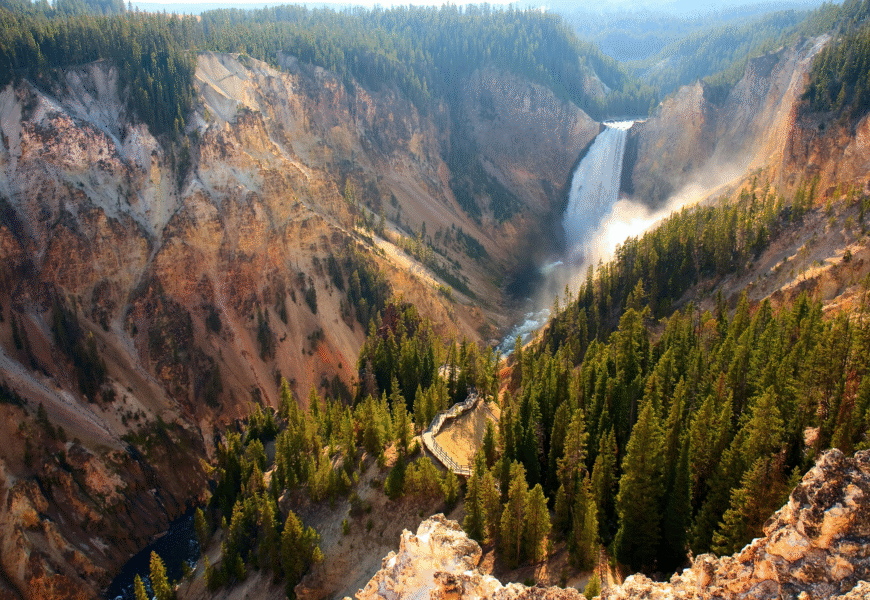
Stepping into Yellowstone National Park feels less like visiting a nature reserve and more like landing on another planet. The ground hisses and steams, the air carries the faint scent of sulfur, and massive beasts roam freely across vast valleys. As the world’s first national park, established in 1872, Yellowstone has captured the imagination of travelers for over a century. Spanning 2.2 million acres across Wyoming, Montana, and Idaho, it offers a diversity of landscapes that few other places on Earth can match.
The Heat Beneath Your Feet: Geothermal Wonders
Yellowstone sits atop an active supervolcano, which fuels the largest concentration of hydrothermal features in the world. There are over 10,000 unique thermal features here, meaning you are never far from the earth’s heat.
The Power of Geysers
Old Faithful is the park’s most famous resident, and for good reason. It is remarkably predictable, erupting roughly every 90 minutes and shooting boiling water over 100 feet into the air. However, it isn’t the only geyser worth seeing. The Upper Geyser Basin alone contains nearly 25% of the world’s geysers. Walking the boardwalks here allows you to witness smaller, frequent eruptions and the sputtering behavior of features like the Castle Geyser.
Technicolor Hot Springs
While geysers offer action, hot springs provide the color. The Grand Prismatic Spring in the Midway Geyser Basin is the crown jewel. It is the third-largest hot spring in the world and is famous for its rainbow-like coloration. These vivid bands of orange, yellow, and green are created by heat-loving bacteria living in the water. When visiting, expect crowds, especially during midday. To get the iconic view of the colors, consider hiking the Fairy Falls trail to the overlook rather than just walking the boardwalk at ground level.
Mud Pots and Fumaroles
Not all thermal features are filled with clear water. Mud pots are acidic features where microorganisms break down rock into clay. The result is a bubbling, glooping cauldron of mud that sounds as strange as it looks. The Fountain Paint Pot area is a great place to see these. Fumaroles, or steam vents, are the hottest surface features in the park, hissing loudly as they release steam and gas.
The Serengeti of North America
Yellowstone is often compared to the African Serengeti because of its high density of large mammals. For many visitors, the wildlife is the primary draw.
The Bison of Wonder
You will see bison. In fact, you will likely see hundreds of them. The park is home to the oldest and largest public bison herd in the United States. They often graze near the roads and sometimes decide to walk right down the center line, causing the famous “bison jams.” Patience is essential here; you simply have to wait for the herd to move.
Predators on the Prowl
Yellowstone is one of the best places in the lower 48 states to see wolves and bears.
- Wolves: The Lamar Valley in the park’s northeast corner is the best place to spot wolf packs. They are elusive, so early mornings and evenings are your best bet. Spotting scopes are standard gear for wolf watchers.
- Bears: Both grizzly bears and black bears inhabit the park. Grizzlies are often seen digging for roots in open meadows, while black bears are more likely to be spotted near the tree line.
Elk and Moose
Elk are incredibly common, especially around Mammoth Hot Springs, where they often lounge on the manicured lawns of the historic buildings. Moose are rarer and tend to stick to marshy areas and willows, particularly in the southern parts of the park.
Hitting the Trails
While driving the loop roads offers spectacular views, stepping away from the pavement reveals a quieter side of the park. Yellowstone has over 900 miles of hiking trails tailored to every ability level.
Easy Strolls
If you are looking for high rewards with low effort, the boardwalks around the thermal basins are perfect. For a bit more nature without a strenuous climb, the Storm Point Loop near Yellowstone Lake is a flat, 2.3-mile trail that takes you through forests to a stunning rocky promontory overlooking the water.
Moderate Hikes
For those wanting to get their heart rate up, Bunsen Peak offers a great challenge. It is a 4.6-mile round-trip climb that provides panoramic views of the Golden Gate Canyon and the Mammoth Hot Springs area.
Strenuous Climbs
If you are an experienced hiker looking for a summit, Mount Washburn is a classic. The trail climbs steadily to a fire lookout at over 10,000 feet. From the top, you can see the entire expanse of the park, and in July, the slopes are covered in wildflowers. Bighorn sheep are often seen near the summit.
Staying Safe in a Wild Land
Yellowstone is not a theme park. The dangers here are real, and safety should be your top priority.
Respect the Wildlife
The animals in Yellowstone are wild and unpredictable. Park regulations require you to stay at least 100 yards (the length of a football field) away from bears and wolves, and 25 yards away from all other animals, including bison and elk. Bison may look like slow-moving cattle, but they can sprint three times faster than a human. Never approach an animal for a selfie.
Watch Your Step
The thermal areas are fragile and dangerous. The crust around a geyser or hot spring might look solid, but it can be paper-thin, breaking easily under human weight to reveal boiling water beneath. Always stay on designated boardwalks and trails.
If you are nervous about navigating these hazards on your own, booking guided tours in Yellowstone can be a smart move. Professional guides know the terrain, understand animal behavior, and can ensure you see the highlights safely while learning about the park’s complex ecology.
Timing Your Visit
Yellowstone changes drastically with the seasons, and when you visit determines what kind of experience you will have.
- Summer (June–August): This is the peak season. All roads and facilities are open, and the weather is generally pleasant. However, this is also when crowds are at their highest. Expect traffic delays and busy boardwalks.
- Shoulder Seasons (April–May and September–October): These months offer a reprieve from the crowds. In spring, you might see baby animals, while fall brings the elk rut (mating season) and vibrant foliage. Be prepared for unpredictable weather; snow is possible in any month of the year.
- Winter (November–March): Most park roads are closed to regular traffic, transforming Yellowstone into a snowy quietude. You can access the interior via snowcoach or snowmobile. It is a magical time to visit, with steam from the geysers rising dramatically against the frozen landscape.
Capturing the Magic: Photography Tips
Bringing home the perfect shot requires some preparation. The lighting in Yellowstone is harsh during midday, which can wash out the colors of the hot springs and make landscapes look flat.
- Golden Hour: The best light is at sunrise and sunset. This is also when animals are most active, giving you the best chance for wildlife photography.
- Gear: If you want photos of bears or wolves, you need a telephoto lens. Relying on a smartphone zoom will result in grainy photos and encourage dangerous behavior by trying to get too close.
- Steam and Fog: In the cool mornings, the steam from thermal features can be thick. Wait for a breeze to clear the air, or use the steam creatively to add mystery to your composition.
Conclusion
Yellowstone is a land of extremes—fire, ice, fragile geology, and abundant wildlife. From watching Old Faithful erupt to sitting by Yellowstone Lake, the park lets you disconnect from modern life and experience nature at its most raw. With preparation and respect for the environment, your visit to Yellowstone will be an unforgettable adventure.